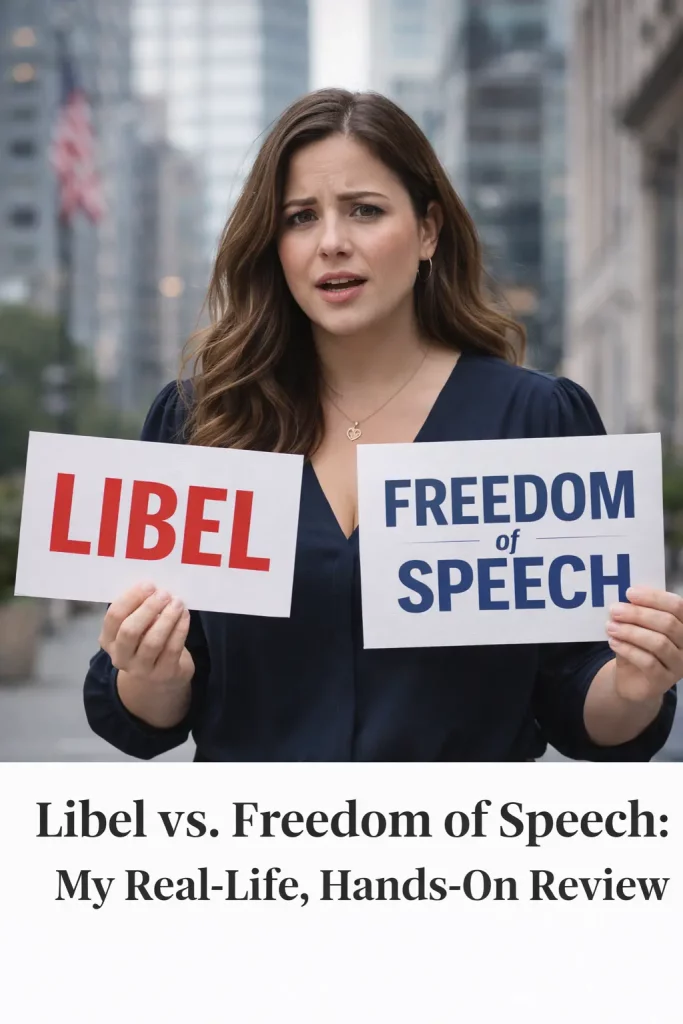
I test gear. I test apps. And, weirdly, I test words. Words can help, and they can hurt. I learned that the hard way. So here’s my plain, first-person take on libel vs. free speech—what I’ve lived, what I’ve seen, and what I now do every time I hit “post.” You can also read my deeper dive on the same tug-of-war here.
Quick refresher, no fluff
- Freedom of speech: You can share ideas, opinions, and facts.
- Libel: A false written statement that harms someone’s reputation.
- Slander: Same idea, but spoken.
- One key rule: Opinions are safer. False facts can get you sued.
Need more context? You can explore a trove of global press-freedom data and real-world defamation cases at Free Press Index to see how different countries balance speech rights and libel protections.
Simple, right? Not always.
The brunch post that bit me
A few years back, I posted a spicy review of a local brunch spot. I won’t name them. The eggs were cold, and I thought I saw a fruit fly near the juice bar. I wrote, “They serve dirty food.” That line? It read like a fact. And it hurt them.
The owner messaged me. It wasn’t a rage text. It was calm. They shared their health report and a same-day re-check. Clean. Like spotless clean. I felt my stomach drop.
I posted an update. I said I was wrong to state it as fact. I kept my opinion on the cold eggs. I also added context: I saw what looked like a fly, but I didn’t confirm it. Was it fun to admit that? Nope. Was it right? Yes.
That day taught me this: “In my experience” if it’s an opinion. Evidence if it’s a fact. If you’re not sure, say you’re not sure.
The time our company got hit with lies
I also run community for a tech brand. One week, a user claimed our device “stores your photos and sells them.” Strong claim. Also false. It spread fast. Folks were scared.
We gathered proof. We showed our privacy policy in plain words. We posted screenshots of settings. We asked the poster to correct the claim. We flagged the false posts. Our lawyer talked about “libel” and “harm.” I drank too much coffee.
It worked. Most people got it. A few did not. But our reply was clear, calm, and true. That’s the thing—free speech does not mean free from facts. Claims need proof. For a blow-by-blow look at raising hard truths inside a company, peep my candid write-up on speaking up at work.
Big cases that shaped my thinking
I didn’t make these up. These are real, public cases you can look up by name.
-
New York Times v. Sullivan (1964): This set a high bar for public officials. To win a libel case, they must show “actual malice”—which means the speaker knew it was false or didn’t care to check. It protects hard reporting. It also forces care. For a concise historical recap, see the Britannica overview.
-
Hustler Magazine v. Falwell (1988): A wild one. A crude parody ad caused a lawsuit. The court said satire, even harsh satire, can be protected if no one would take it as a real fact. Parody lives. Feelings still get bruised, though. You can read the full LII summary for the case here.
-
“McLibel” case (UK, 1990s): Two activists passed out leaflets accusing McDonald’s of bad stuff. McDonald’s sued. The case dragged on for years. Parts were found false. Parts were not. It showed how tough UK libel laws were back then. It also showed how speech and power can clash.
-
Alex Jones and the Sandy Hook families: Courts found he defamed the families with false claims. Huge damages followed. The harm was deep and very real. This one still makes my chest heavy.
-
Dominion Voting Systems vs. Fox News (settled in 2023): Big payout. Why? The claims aired about the company were false, and the case showed what ignoring truth can cost. Words aren’t free when they break people.
These cases don’t all say the same thing. But they draw the line. Opinions, fair comment, parody—often okay. Stated-as-fact lies that harm—often not.
Ratings, if you’ll let me be cheeky
- Freedom of speech: 5/5 for courage. 5/5 for sunlight. It lets us question power, share joy, and fix mistakes in public.
- Libel laws: 4/5 for guardrails. They protect people from lies. But they can be used to scare folks too, which is messy.
Do these two clash? Sure. They also keep each other honest. It’s a little like brakes and a gas pedal. You need both to steer.
What I do now, every time I publish
You know what? I still post hot takes. I just post them smarter.
- If it’s my view, I say it’s my view.
- If it’s a fact, I show where it came from.
- If I’m not sure, I say I’m not sure.
- I keep screenshots, dates, and names (private unless needed).
- I ask for comment on serious claims, even if it slows me down.
- I fix mistakes fast. No weird pride about it.
- I avoid loaded words that sound like verdicts: “fraud,” “scam,” “stole,” unless a court said so or I have iron proof.
- I learn my local laws. Anti-SLAPP laws can help when a lawsuit tries to shut you up. Not everywhere has them.
These habits don't just apply to Twitter threads and company blogs. Even on niche social spaces where conversations can get, well, a little more playful—think dedicated French swinger communities like NousLibertin—the expectations around truthful statements and defamation still exist; browsing the platform’s guidelines and user discussions can give you a real-world sense of how free expression coexists with clear rules against harmful claims. Closer to home, a regional classifieds board operating in the post-Backpage era—take a look at Backpage Deland—offers another practical illustration; the site’s posting rules walk you through how free-form personal ads must still dodge libel by sticking to verifiable statements and providing clear disclaimers.
A small digression about tone
Tone can trick you. “They’re crooks” feels like a joke on a bad day, but to a reader, it can sound like a claim. Instead, I’ll write, “This felt unfair,” or “I think this policy misleads users.” See the difference? One is a punch. The other is a clear opinion.
Also, caps lock is never your friend.
When I still get nervous
Sometimes I write and my heart thumps. I’ve paused a post for a day. I’ve asked a friend to read. I’ve cut a line I loved because it read like a fact I couldn’t prove. Do I like that? Not really. But I like sleeping at night.
And here’s the twist: the stuff I publish now is stronger. Cleaner. Harder to shake. People trust it more. That feels good.
Final word from a mouthy reviewer
I love free speech. I also love fairness. Libel law, when used right, protects regular people from lies that stick like gum on a shoe. The trick is simple to say and hard to live: Speak bold truths. Label opinions as opinions. Correct fast. Keep receipts. And remember that people—real people—sit on the other side of your screen.
Freedom of speech lets us talk. Libel law makes us think. I need both. So do you.